Prime Minister Anutin Charnvirakul on Thursday delivered his government’s policy statement to parliament, underscoring his commitment to strengthening national stability and self-reliance and enabling Thais to regain their economic footing.
“I will do everything possible to ensure Thailand is strong from within, that Thais can stand on their own feet, that the economy is competitive, and that the world has confidence in Thailand,” he pledged in the 68-minute address.
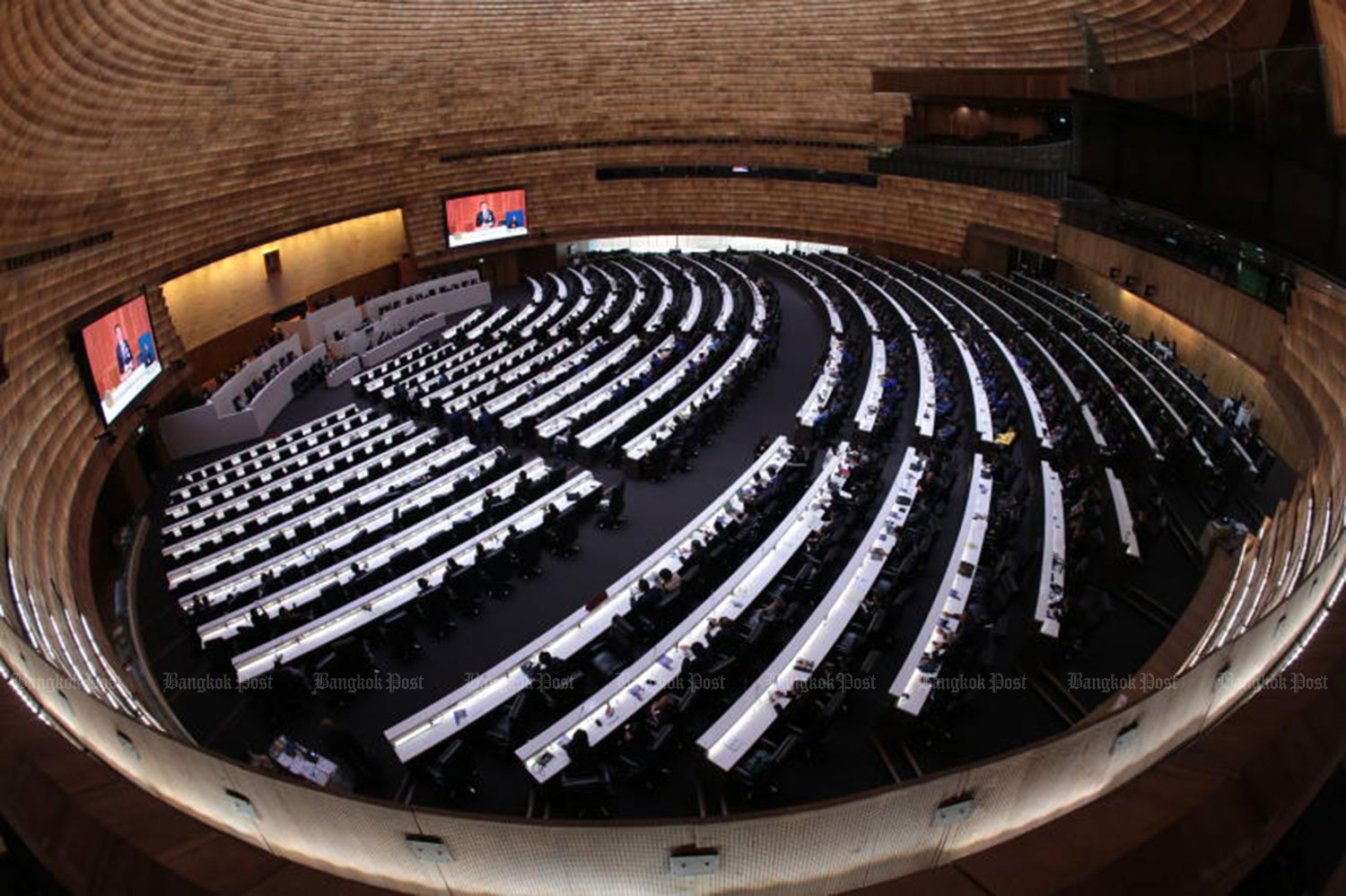
The delivery of the statement to a joint sitting of MPs and senators, with House Speaker Sophon Zaram presiding, will be followed by a debate that will conclude on Friday. After that, the government will finally assume full administrative authority, two months after the Feb 8 election.
The atmosphere ahead of the address was lively, with the prime minister, who also serves as interior minister, leading cabinet members to attend, listen to the debate and respond to lawmakers.
Mr Anutin began reading the statement at 9.05am, saying that his Bhumjaithai Party-led coalition was now ready to urgently carry out the policies pledged to the public.
The administration would maximise the use of available resources while maintaining fiscal discipline, accelerate budget disbursement, and expedite the enactment of the 2026 fiscal budget bill, he said.
The move is aimed at easing the impact on the public from the Middle East conflict, with particular emphasis on assistance for vulnerable groups, businesses and the agricultural sector. The government will also fast-track preparation for the 2027 budget bill to ensure it takes effect in line with the fiscal calendar that runs from Oct 1 to Sept 30, said Mr Anutin.
The prime minister said urgent economic measures would focus on expanding opportunities, job creation and equal access to livelihoods across all groups, while also resolving household debt — among the highest in Asia — in a comprehensive manner.
The government, he said, is also preparing to roll out a new phase of the popular “Khon La Khrueng Plus” (Half Half Plus) co-payment scheme, alongside programmes to help people obtain future-ready skills and financial literacy.
As well, measures will be introduced to reduce business costs for small and medium-sized enterprises, strengthen the role of local authorities in area-based development through a proposed hometown tax law, and raise standards in science, technology and innovation to lay the foundations for a new economy and attract strategic investment.
Turning to trade, Mr Anutin said Thailand would deepen global economic integration by strengthening competitiveness, enforcing strict and transparent inspections of product origins that add no domestic value, and promoting Thai goods and services abroad through a coordinated “Team Thailand” approach.
The agricultural sector, meanwhile, will be upgraded into a modern agro-industry and food hub, while tourism will be developed to position Thailand as a key regional destination.
On foreign affairs and national security, Mr Anutin said the government would reinforce international confidence in Thailand, deepen ties with middle powers and new regional partners, and pursue diplomatic balance among global power blocs.
Economic diplomacy would be strengthened, he said, while border security and cross-border threats will be addressed in cooperation with neighbouring and regional countries.
Regarding Thai Cambodian relations, Mr Anutin said disputes would be handled peacefully through existing bilateral mechanisms, while a study on revoking an ineffectual 2001 memorandum of understanding on maritime boundaries would be expedited.
The government will also review visa-free policies and related laws to cut off financial channels used by scam networks, transnational criminals, money-laundering operations and grey capital groups, he said.
To deal with the increasing threat of illicit drugs and gambling, he said law enforcement would be intensified against criminal networks and influential figures, while gambling would be strictly controlled. Officials found to have neglected their duties or allowed drug problems to spread in their jurisdictions would face severe disciplinary and criminal penalties, including immediate suspension.
The prime minister said the government would also modernise national defence systems and enhance military readiness in line with present-day security contexts. Procurement and upgrading of weaponry, whether domestically produced or imported, must be cost-effective, efficient, transparent and fully accountable.
A volunteer soldier scheme would be developed alongside reform of conscription. The government plans to recruit 100,000 volunteer soldiers under four-year contracts with remuneration he said.
Social development will ensure genuinely free education, linking learning to employment opportunities, and promoting lifelong learning accessible anytime and anywhere through free digital platforms.
Sports development would prioritised to raise national standards, while the healthcare system and health insurance schemes will be strengthened. The Social Security Act will be revised to improve benefits and service quality.
Turning to disaster management, failures of which were exposed during the southern floods last year, he said investment would be accelerated in water infrastructure, early-warning systems and unified emergency response to reduce losses and ensure timely assistance. A national disaster insurance system will also be developed.
Mr Anutin said public administration reforms would include a transition to a smart digital government, with a “super licence” bill to be enacted within 180 days and a package of omnibus laws targeting outdated legislation to be passed within one year.
Public procurement laws would be amended to prioritise value for money rather than lowest price alone, and stricter measures would be imposed on state contractors causing damage to the public interest. Structural corruption would be tackled seriously through ethical standards and misconduct controls to ensure corruption-free governance.
He said the administration would operate under an integrated framework with five strategic pillars: macroeconomy, production and trade, infrastructure, social welfare, and foreign affairs and security. Each area will have clearly designated leaders responsible for delivering tangible results.
He reaffirmed that the government would prioritise national and public interests under fiscal discipline, pledging to tackle economic hardship and ensure stability.
Ref : Bangkok Post